
Revenues and marginal prices — an overview covering all markets
In April, the balancing capacity markets in Germany and Austria showed a strong price increase in the negative segments. Marginal prices rose significantly in both aFRR- and mFRR-. The positive markets, on the other hand, presented a more differentiated picture, with declining marginal prices in Austria and moderate to strong increases in Germany. At the same time, the FCR continued its upward trend, recording strong revenue growth in both countries.
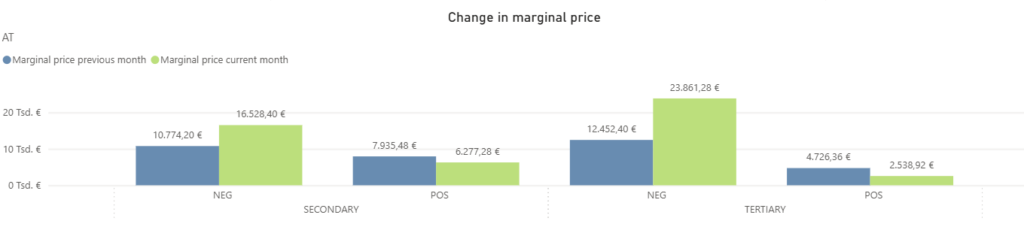
In Austria, marginal prices in the aFRR- recorded a massive increase of around 53% to 16,528 €/MW/h in April. In contrast, the aFRR+ saw a noticeable decline from 7,935 €/MW/h in the previous month to 6,277 €/MW/h. A similar divide was evident in the mFRR. Here, the mFRR- surged massively with a growth of almost 92%, whereas the mFRR+ showed a downward trend and closed at 2,539 €/MW/h. This represents a noticeable downturn compared to the 4,726 €/MW/h of the previous month. The FCR developed very positively, with revenues climbing sharply by nearly 25% to a strong 17,080 €/MW/h.

Germany also presented a consistently dynamic picture, which nevertheless showed some notable differences to the Austrian market. In line with the development in the neighboring country, marginal prices in the aFRR- recorded a massive increase, which was even more pronounced here with a surge of around 143% to an impressive 30,454 €/MW/h in April. In clear contrast to the decline in Austria, the aFRR+ also gained ground in Germany and climbed from 10,471 €/MW/h in the previous month to 13,375 €/MW/h. As in Austria, this upward trend was also reflected in the mFRR-, which virtually doubled with a growth of a good 100% to 15,824 €/MW/h. In contrast to the clearly downward trend of the mFRR+ in Austria, it proved to be significantly more stable in Germany and recorded a minimal increase of just under one percent to 1,504 €/MW/h. The FCR closed very successfully and in perfect alignment with the market development in the neighbouring country, with revenues climbing by around 29% to a strong 16,523 €/MW/h.
Comparison of revenues generated with FPH and the market average in the aFRR
In April, the balancing capacity markets in Germany and Austria recorded a continued dynamic development, which led to a strong increase in revenues, particularly in the negative segments. This positive development was also reflected in the significant rise of the market average. FlexPowerHub was once again able to efficiently capture market trends through precise forecasting and achieve a consistently strong operational performance in almost all segments.
Austria
In the Austrian aFRR+, revenues achieved with FlexPowerHub recorded a moderate decline to 4,520 €/MW/h in April, after reaching 5,498 €/MW/h in the previous month. The market average also declined slightly over the same period from 5,862 €/MW/h to 4,743 €/MW/h, meaning our revenue development was in line with the overall market dynamics. In this environment, the bid acceptance rate developed very positively, rising noticeably from 90% to an outstanding 94%. At the same time, our forecast performance continued to improve and closed at a strong 95%.
The picture in the aFRR- was significantly more dynamic. Here, revenues surged by around 54% to a remarkable 10,192 €/MW/h, while only 6,611 €/MW/h were recorded in March. Parallel to this, the market average climbed sharply by a good 60% from 7,513 €/MW/h to 12,039 €/MW/h. The bid acceptance rate remained at a consistently high level of 91%. Forecast performance remained at a solid level of 85% in this more volatile environment.

Germany
The aFRR+ presented a similar picture to Austria, with revenues generated with FlexPowerHub easing slightly to 6,053 €/MW/h. This corresponds to a moderate downturn compared to the 6,436 €/MW/h from the previous month. In contrast to the development in the neighboring country, however, the market average here recorded a slight increase from 7,825 €/MW/h to 8,030 €/MW/h. In this environment, our operational performance held its ground with a strong bid acceptance rate of 88%. With this, we continue to operate at an absolutely high level and ensure reliable market access. Likewise, the forecast performance closed at a solid 75%.
Also in perfect alignment with the Austrian market, the German aFRR- recorded massive revenue growth. Here, the revenues achieved with FlexPowerHub climbed by a good 51% to a strong 11,391 €/MW/h, after 7,555 €/MW/h were recorded in March. The market average followed this rapid upward movement and rose markedly from 9,057 €/MW/h to an impressive 14,735 €/MW/h. Particularly positive to highlight is the bid acceptance rate, which, in clear contrast to the slight decline in Austria, improved significantly here from 72% to 86% and excellently captured the market potential. Despite the enormous dynamics, the forecast performance leveled off at a solid 77%.

Market volatility
In April, volatility in the secondary balancing capacity markets in Austria and Germany presented a very differentiated picture. In Austria, a rhythm of continuous fluctuations was established, where the absolute extreme level in the positive segment even dropped noticeably in direct comparison to March. This was in clear contrast to the rapid development in Germany. Here, gigantic isolated events on 24 April broke through the otherwise noticeably calm market environment compared to the previous month and caused unprecedented record values. Our operational key figures impressively demonstrate that FlexPowerHub not only securely masters these highly demanding market dynamics but also excellently translates them into economic success.

In the Austrian aFRR-, April was characterized by continued dynamics. Prices showed regular fluctuations, which intensified even further, particularly in the second half of the month. The absolute monthly high was reached on 26 April at 12:00 with a strong 133 €/MW/h. This corresponds to a striking increase compared to March, when the highest spike was still around 83 €/MW/h. While the previous month was therefore characterized by steady volatility at a higher level, the intensity of prices increased noticeably once again in April. In this more volatile environment, our forecast models proved their enormous strength. The forecast performance closed at a very solid 85%, proving that we were able to anticipate the fluctuations extremely accurately. At the same time, we maintained the bid acceptance rate at an outstanding level of 91%. This combination highlights that FlexPowerHub ensures nearly continuous market access even with increased market dynamics and highly successfully captures lucrative price spikes for our customers.

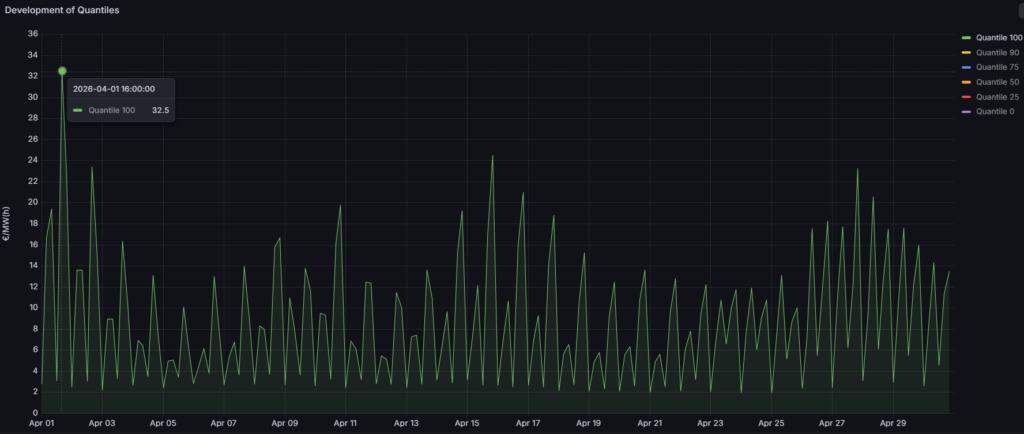
A significantly calmer development, however, was evident in the aFRR+. Here, the month started directly on 1 April at 16:00 with the monthly high of 33 €/MW/h. As the month progressed, prices mostly leveled off at a more moderate level and exhibited continuous but far less extreme fluctuations. In a direct comparison with the previous month, the peak price level in this segment thus calmed down noticeably. While March still recorded a very dynamic upward movement with a maximum of around 61 €/MW/h, April was significantly flatter. Our algorithms leveraged this calmer market phase in an impressive manner. The already high forecast performance was boosted to a brilliant 95%. In parallel, the bid acceptance rate climbed to an outstanding 94% in this stable environment. These values are clear proof that we almost fully capture the available revenue potential in steady markets and place our clients’ bids with maximum precision.

In contrast to the continuous volatility in Austria, the German aFRR- presented a completely different market characteristic. For long stretches, prices remained at an extremely calm baseline. However, this quiet was completely broken by an unprecedented extreme event on 24 April at 08:00. The price literally exploded to an absolute record value of 2,093 €/MW/h. In direct comparison, this isolated outlier marks an extraordinary special situation and a complete departure from the market picture of the previous month. March was still characterized by relatively stable dynamics and more frequent fluctuations with a high of merely 89 €/MW/h, without such extreme individual jumps occurring. Such sudden gigantic leaps place the highest demands on any optimization system. FlexPowerHub mastered this challenge excellently. This is particularly impressively demonstrated by the massively increased bid acceptance rate, which rose from 72% in the previous month to a strong 86%. We were therefore successfully positioned in the market exactly when it mattered most. A forecast performance of 77% also impressively proves that our models confidently master the balance between risk and revenue maximization during such unpredictable extremes.

Also in direct connection with the events in the negative segment, the German aFRR+ showed a gigantic price spike at exactly the same time. On 24 April at 08:00, the value climbed massively to 405 €/MW/h, whereas the market acted completely unremarkably for the rest of the month. Analogous to the incredible development in the aFRR-, this represents a massive leap and a complete structural shift compared to March. In the previous month, a more rhythmic price dynamic with regular fluctuations and a maximum of around 73 €/MW/h had established itself. April, however, fell back into a pattern of an extreme isolated event. Such an abrupt market event requires extremely robust risk management. Our systems delivered once again here. With a strong bid acceptance rate of 88%, we ensured excellent market coverage. The forecast performance of 75% underlines the quality of our short-term optimization strategies. It clearly proves that FlexPowerHub secures substantial revenues even during an abrupt return to isolated shock situations, without exposing the portfolios to disproportionate risks.

1DA vs. 2DA
In April 2026, the trend of a superior performance of the 1DA forecast compared to the 2DA impressively continued across all analyzed aFRR markets. In a market environment characterized by enormous dynamics in the negative segments and partly unprecedented record values, the shorter forecast horizon in Austria and Germany once again enabled an optimized bidding strategy. This led to consistently high bid acceptance rates and significantly increased total revenues.
In Austria, the results underpinned the clear economic added value of the 1DA in both directions. In the aFRR-, the 1DA achieved a strong bid acceptance rate of 88%, while the 2DA stood at only 72%. In terms of revenues, this led to revenues of 10,056 €/MW/m for the 1DA compared to 9,112 €/MW/m for the 2DA. This resulted in an additional revenue of 944 €/MW/m. The advantage also remained highly prominent in the aFRR+. With an outstanding bid acceptance rate of 95% compared to 79% for the 2DA, the 1DA generated revenues of 4,522 €/MW/m, thereby achieving a considerable additional revenue of 868 €/MW/m.

The German market reflected this positive development with equally strong values. In the aFRR-, the 1DA secured a high bid acceptance rate of 90%, while the 2DA stood at only 79%. In terms of revenues, the 1DA was able to generate an additional revenue of 1,163 €/MW/m with 11,202 €/MW/m compared to 10,039 €/MW/m for the 2DA. In the aFRR+, the lead of the 1DA was also clearly pronounced. The 1DA maintained its ground at an absolutely solid level here with a convincing bid acceptance rate of 84% compared to 78% for the 2DA. With revenues of 6,008 €/MW/m compared to 5,381 €/MW/m, the 1DA also secured a very attractive additional revenue of 627 €/MW/m in this segment.
In summary, April 2026 once again illustrates that the 1DA forecast provides a consistent advantage in both countries and directions. Especially given the enormous market dynamics observed in Germany this month, the short-term adaptability of the 1DA fully paid off through more efficient market participation and noticeably higher revenues.
Click here to access our forecast dashboard, where you can view all values in detail.