
Revenues and marginal prices — an overview covering all markets
A fundamental turnaround took place in the balancing capacity markets in Germany and Austria: While the positive segments cooled off noticeably after a strong June, the negative markets recovered significantly in some areas, becoming the main growth drivers. FCR showed a slight downward correction in both countries, but remained at a solid level. Compared to the deep, widespread price slump in July 2025, a clear directionally driven dynamic established itself this time.

This market reality was particularly evident in Austria. In the aFRR-, the marginal price rose by 11% to 16.078 €/MW/h, while the aFRR+ dropped by 31% to 7.632 €/MW/h. The tertiary market developed even more dynamically: mFRR- leaped by 36% to 23.977 €/MW/h, whereas mFRR+ plummeted by 48% to 4.925 €/MW/h. FCR revenues generated with FPH declined slightly by 6% to 18.266 €/MW/h.

Germany showed an almost identical pattern. While aFRR- remained virtually stable at 16.891 €/MW/h, mFRR- picked up by 18% to 15.929 €/MW/h. In contrast, positive markets experienced massive declines: aFRR+ dropped by 35% to 9.990 €/MW/h, and mFRR+ collapsed by 62% to 1.842 €/MW/h. German FCR followed its neighbor with a moderate revenue correction of 5% to 16.447 €/MW/h.
This directionally driven character stands out sharply from the previous year. A widespread downward trend still prevailed in July 2025: Back then, marginal prices for aFRR- plummeted by 37% in Austria and by a staggering 56% in Germany, while aFRR+ suffered losses of 20% and 37%, respectively. mFRR- also recorded declines of nearly 38% in both countries, with FCR dropping by 14% each. Measured against these slumps, the current price level in July 2026 presents itself as significantly more robust. FlexPowerHub successfully absorbed these directionally split dynamics through precise forecasts, efficiently tapping into the potential of the strengthening negative markets.
Comparison of revenues generated with FPH and the market average in the aFRR
A distinctly directionally driven development unfolded in the balancing capacity markets in Germany and Austria, marking a clear counter-movement to the previous month. While revenues in the positive secondary markets dropped noticeably, negative segments gained momentum across the board, providing valuable growth impulses. FlexPowerHub responded to this trend shift with high algorithmic precision: We successfully translated market shifts in the negative domain into increased revenues and improved bid acceptance rates, while our forecasting models effectively cushioned the impact of the general cooldown in the declining positive segment.
Austria
In the aFRR-, the market average climbed by 12% to 12.349 €/MW/h. FPH increased revenues over the same period by 11% to 11.434 €/MW/h, with the bid acceptance rate rising to a strong 97%. Meanwhile, our forecasting performance remained virtually unchanged at 93%. The picture was quite different in the same month of the previous year: In July 2025, FPH revenues plummeted by 38% to 9.564 €/MW/h, with a bid acceptance rate of 84%.
The aFRR+ experienced the expected market calming: The market average dropped by 26% to 6.219 €/MW/h, while FPH revenues fell by 32% to 4.775 €/MW/h. In parallel, the bid acceptance rate settled at 83%, while the forecasting performance reached a solid 77%. This cooldown aligns with the trend from the previous year, when revenues in July 2025 also declined by 13% to 8.820 €/MW/h.

Germany
The German balancing capacity market adapted this split pattern in the negative segment in a very stable manner. In the aFRR-, the market average recorded a slight increase of 3% from 13.076 €/MW/h to 13.523 €/MW/h. Revenues generated with FlexPowerHub followed this trend, rising by 1% to 11.212 €/MW/h. The bid acceptance rate developed very positively, jumping from 74% in June to a strong 82% in July. Our forecasting models convinced with high precision and a performance of 83 %. While the negative segment in the previous year (July 2025) collapsed by 35% to 10.186 €/MW/h, we were able to not only hold our ground this year, but further expand our position.
In the aFRR+, the cooldown of the neighboring country was reflected even more clearly. The market average dropped significantly by 28% to 7.943 €/MW/h. FlexPowerHub effectively cushioned this decline, as our revenues only fell by 23% to 5.977 €/MW/h. A key driver was the improved forecasting performance, which climbed from 70% in June to a strong 75%. At the same time, the bid acceptance rate settled at 82 % . Here too, the comparison with the previous year confirms the familiar picture: In July 2025, revenues in the German aFRR+ likewise fell by 18% to 9.230 €/MW/h.

Market volatility
A noticeable easing of volatility was observed in the secondary balancing capacity markets compared to the more turbulent preceding months. Extreme price peaks flattened noticeably in both countries, giving way to a more reliable and rhythmic market dynamic. Nevertheless, the remaining activity, driven in particular by summer solar generation, offered highly attractive revenue opportunities. Our forecasting models anticipated these smoother trajectories with excellent accuracy.
Austria

A noticeable cooldown took place in the aFRR+ compared to the lively dynamics of the previous month. The absolute peak price occurred right at the start of the month on July 1 at 20:00 with 95,9 €/MW/h. This evening peak reflects the typical summer vulnerability of the positive market when solar generation rapidly drops after sunset while residual load in the system remains at a high level. Aside from this early isolated spike, the price level calmed down significantly throughout the rest of the month, mostly moving below the 40 €/MW/h mark. Compared to June, when strong spikes of up to 149 €/MW/h were recorded, volatility decreased. However, compared to July 2025, when the maximum stood at 74,7 €/MW/h, the market acted slightly more turbulent this year. Our algorithms smoothly cushioned these changes, securing a solid bid acceptance rate of 83% alongside a forecasting performance of 77% despite the calmer environment.

The aFRR- presented a remarkably consistent and predictable side. The absolute peak of the month was recorded on July 24 at 12:00 with 98,1 €/MW/h. This midday peak can be attributed to the typical summer feed-in peak of photovoltaics, which leads to a temporary oversupply in the power grid on sunny days. In direct comparison to June, where the maximum stood at an almost identical 98,9 €/MW/h, the level of price spikes remained absolutely stable. Looking back at the previous year’s figure from July 2025 also reveals a striking similarity in market characteristics, with a peak value of 91,5 €/MW/h. These reliable structures provided optimal support for our systems. FlexPowerHub utilized this calm environment highly efficiently, boosting the bid acceptance rate in the Austrian aFRR- to an outstanding 97% and backing it with an excellent forecasting performance of 93%.

Germany

The aFRR+ seamlessly joined the overall calming trend, yet presented a parallel to the Austrian market. Right at the start of the month on July 1 at 20:00, a first prominent spike of 110 €/MW/h occurred. This peak impressively illustrates the cross-border phenomenon of the evening sunset, where the abrupt drop in photovoltaic output simultaneously requires rapid activation of positive balancing power in both countries. The absolute monthly high was ultimately reached on July 16 at 20:00 at 118 €/MW/h, once again highlighting this recurring evening pattern. Apart from these two spikes, the market mostly moved at a stable level below 50 €/MW/h. Compared to June, when quotations climbed up to 188 €/MW/h, the peak price level dropped noticeably. Nevertheless, the market remained above the previous year’s level from July 2025, when the market recorded a maximum of only 89,2 €/MW/h. Our algorithms adapted precisely to this shift in dynamics. FlexPowerHub increased forecasting performance to a strong 75% and secured reliable revenues with a bid acceptance rate of 82%.

Normalization in the aFRR- continued consistently following the partly volatile spring months. The highest spike of the month occurred on July 28 at 12:00 at 105 €/MW/h. This midday timing once again illustrates the direct impact of peak solar generation on negative market prices, as massive volumes meet moderate demand on sunny summer days. Compared to the previous month of June, which recorded price spikes of up to 212 €/MW/h, the market cooled down significantly. This normalization is even more pronounced compared to July 2025, when the absolute maximum in the German aFRR- was registered at 161 €/MW/h. These stable market conditions played directly to the strengths of our forecasting models: FlexPowerHub increased the bid acceptance rate to a strong 82% with a customarily precise forecasting performance of 83%.

1DA vs. 2DA
The results for July once again confirm the clear strategic advantage of the 1-Day-Ahead forecast (1DA). Regardless of market direction and country-specific conditions, the shorter forecast horizon delivered the decisive precision needed to maximize revenues. FlexPowerHub translated this agility into higher bid acceptance rates and significant additional revenues in both countries compared to the 2-Day-Ahead forecast (2DA).
The Austrian aFRR- showed increasing momentum: With a bid acceptance rate of 98.39% (2DA: 90.32%), 1DA achieved revenues of 11.365 €/MW/m. The additional revenue of 1.106 €/MW/m (+10.78%) compared to 2DA significantly surpassed the June figure (274 €/MW/m).
In the aFRR+, despite a lower bid acceptance rate compared to June, 1DA generated revenues of 4.586 €/MW/m (2DA: 3.933 €/MW/m). Despite the decline in revenue compared to June, the additional revenue of 653 €/MW/m (+16.60%) remained substantial.
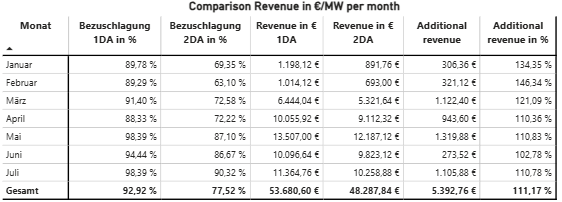
In Germany, the 1DA in aFRR- outperformed its June result with a bid acceptance rate of 97.31% (2DA: 93.55%) and revenues of 11.712 €/MW/m (2DA: 11.226 €/MW/m). The additional revenue of 487 €/MW/m (+4.33%) more than doubled compared to the previous month (221 €/MW/m).
The aFRR+ delivered an outstanding result: With a bid acceptance rate of 77.42% (2DA: 61.83%), revenues reached 5.864 €/MW/m (2DA: 4.538 €/MW/m). The additional revenue of 1.327 €/MW/m (+29.24%) increased significantly once again compared to June (922 €/MW/m), underscoring the strength of the short-term forecast horizon.
Click here to access our forecast dashboard, where you can view all values in detail.