


Mit dem Umstieg auf 15-Minuten-Produkten im Regelarbeitsmarkt (RAM) wird die Anzahl an handelbaren Produkten von 6 auf 96 Produktzeitscheiben erhöht.
Die Automatisierung wird deshalb zum MUSSDie Abrufwahrscheinlichkeit genau zu kennen wird DIE Herausforderung im RAM bei PICASSO & MARI, um optimale Erlöse zu generieren.
Die Betreuung des Regelenergiemarktes wird mit PICASSO&MARI extrem zeitintensiv.
Mit FlexPowerHub werden automatisiert Gebote anhand individueller & aktuellster Parameter berechnet.Bedarf für Flexibilität wächst in den nächsten Jahren sowohl bei Stromerzeugern als bei Stromverbraucher
Die Energiewende ist das größte nationale IT-Projekt aller Zeiten: Die digitale Transformation der Energiewirtschaft ist integraler Bestandteil der Energiewende.
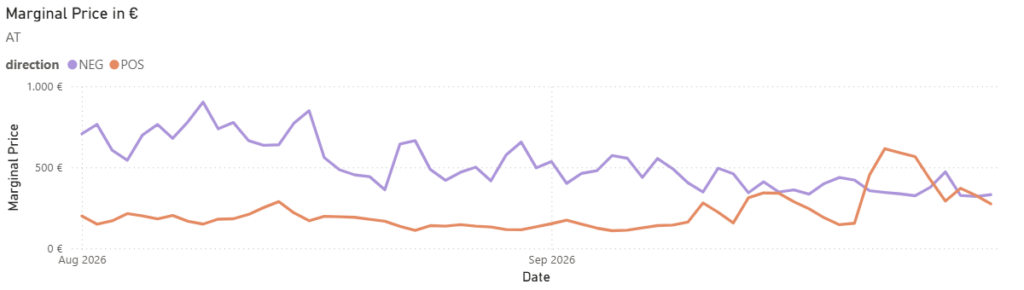
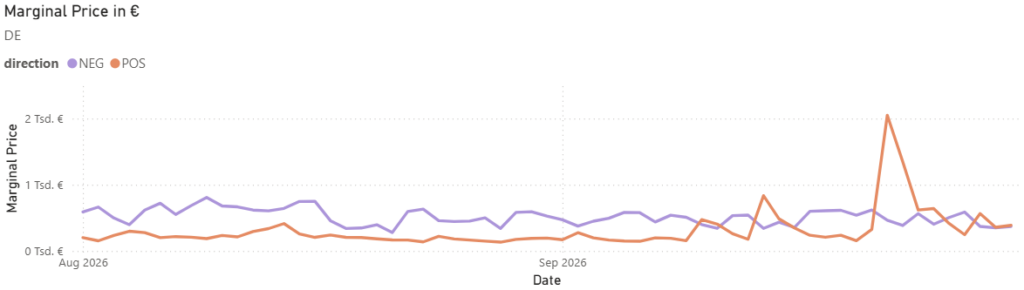
Wir haben das FÜR SIE bereits erledigt & übernehmen zukünftige Änderungen als IHR Servicepartner.Marginal prices have changed direction. For two months, the negative markets had driven growth; now the positive segments recovered in both countries, while aFRR- and mFRR- declined across the board.
This is a pattern that has repeated since early summer: the leading role alternates between positive and negative markets, usually after one to two months. FCR revenues remained largely unaffected by this shift.
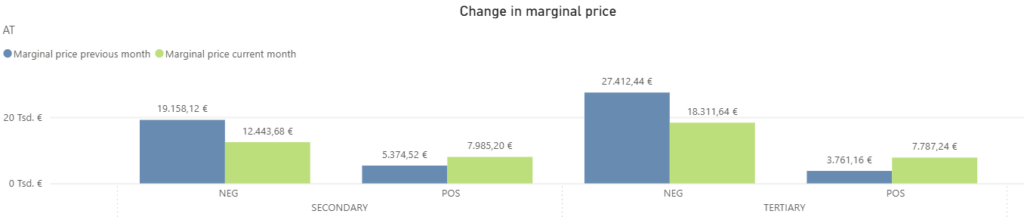
In Austria, the shift was particularly pronounced in the secondary balancing capacity market. The marginal price in the aFRR- lost 35%, falling from 19,158 €/MW/h in August to 12,444 €/MW/h. This is the lowest value since March, and the decline was larger than the previous month’s increase (+19%). The aFRR+ went the opposite way: after two months of declines, it rose by 49% from 5,375 €/MW/h to 7,985 €/MW/h, reaching the July level (7,632 €/MW/h).
In the tertiary market, the same pattern continued with a larger swing. The mFRR+ more than doubled (+107%) from 3,761 €/MW/h to 7,787 €/MW/h and is thus well above the July value of 4,925 €/MW/h. The mFRR- fell by 33% to 18,312 €/MW/h (August: 27,412 €/MW/h). FCR revenues declined by 5% to 18,359 €/MW/h after the strong August, but remain at a high level.
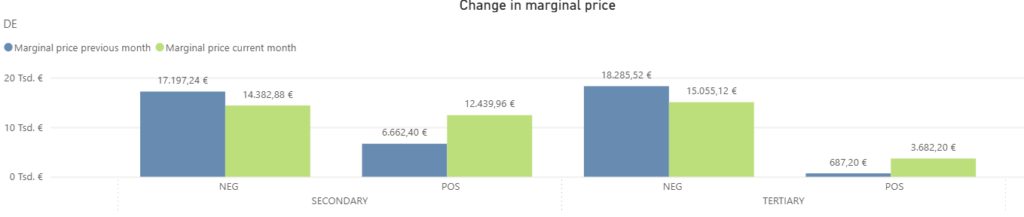
Germany followed the Austrian pattern, with an even larger swing in the positive segment. The marginal price in the aFRR+ rose by 87% from 6,662 €/MW/h in August to 12,440 €/MW/h and is thus back well above the 10,000 €/MW/h mark, which it had narrowly missed in July. The aFRR- fell by 16% to 14,383 €/MW/h. As in Austria, this is the lowest value since March.
In the mFRR, the positive market stands out most, jumping from 687 €/MW/h to 3,682 €/MW/h. That is more than five times the previous value, albeit after a previous month in which the value had fallen to a very low level. It remains below the June level of 4,862 €/MW/h. The mFRR- lost 18% and stands at 15,055 €/MW/h. FCR revenues rose slightly by 1.5% to 16,219 €/MW/h.
The directional reversal of marginal prices is reflected in revenues, and the comparison with the market average shows how FlexPowerHub performs in falling and rising markets. In the negative markets, where the market average fell by 34% (AT) and 19% (DE), the revenues achieved with FlexPowerHub declined significantly less. In the positive markets, the revenues achieved with FlexPowerHub grew clearly by 28% (AT) and 29% (DE), but the market average rose even more strongly, by 40% and 57%.
Austria
In the aFRR-, both the market average and the revenues achieved with FlexPowerHub declined compared to August, but our decline was much smaller: the market average fell by 34% from 15,023 €/MW/h to 9,927 €/MW/h, while our revenues dropped by only 24% from 12,918 €/MW/h to 9,840 €/MW/h. At the same time, the key figures improved noticeably: the bid acceptance rate rose from 78% to 94%, and forecast performance from 86% to a near-perfect 99%.
The aFRR+ moved in the opposite direction. The market average climbed by 40% to 6,218 €/MW/h, while the revenues achieved with FlexPowerHub rose less strongly, by 28% to 4,987 €/MW/h. The key figures were weaker here: the bid acceptance rate fell from 96% to 89% but remains at a high level, and forecast performance declined from 88% to 80%.
Germany
The German aFRR- followed the same pattern: the market average fell by 19% from 14,038 €/MW/h to 11,371 €/MW/h, while the revenues achieved with FlexPowerHub dropped by only 5% from 10,653 €/MW/h to 10,115 €/MW/h. The key figures developed positively as well: forecast performance rose from 76% to 89%, and the bid acceptance rate from 90% to 93%, its highest level since May.
In the aFRR+, the market average climbed by 57% from 5,485 €/MW/h to 8,632 €/MW/h. The revenues achieved with FlexPowerHub lagged behind but still grew significantly, by 29% from 4,522 €/MW/h to 5,824 €/MW/h. The key figures declined as well: the bid acceptance rate fell from 97% to 83%, and forecast performance from 82% to 67%.
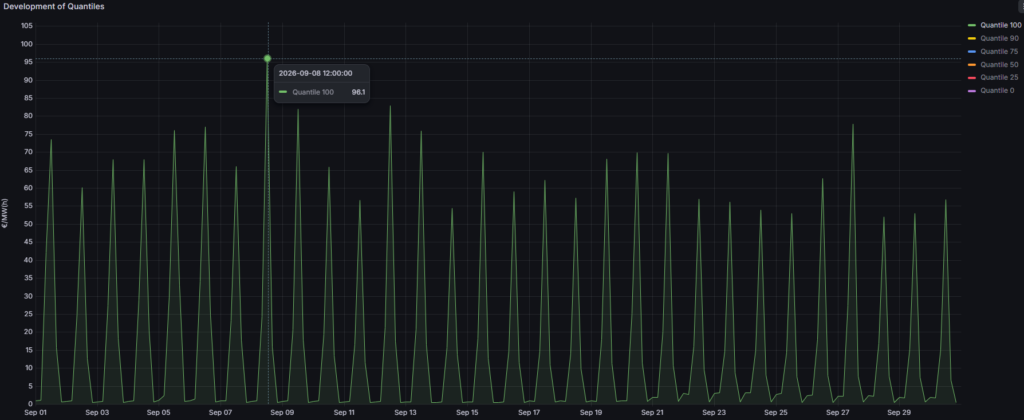
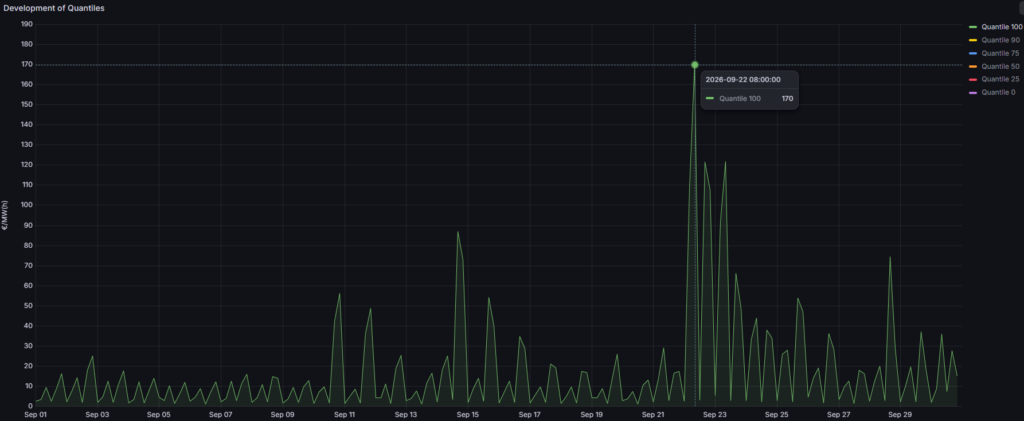
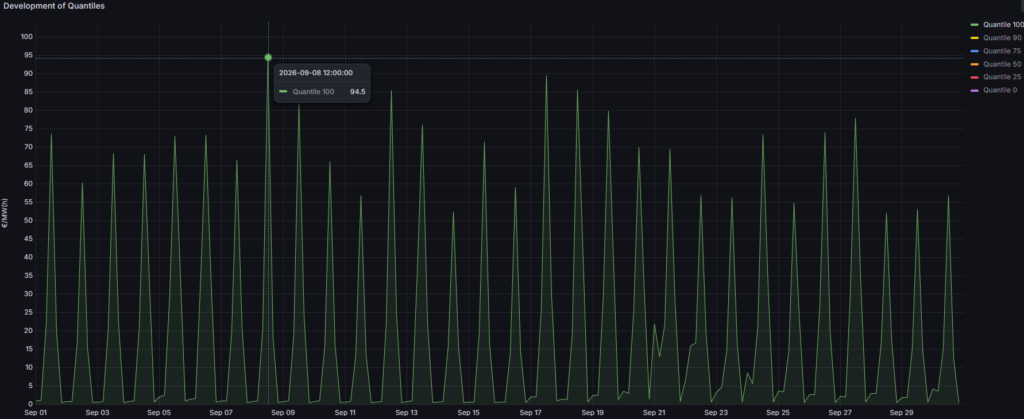
With the price direction, volatility also turned. In the aFRR+, fluctuations were still low in August, with maxima of 40.8 €/MW/h (AT) and 51.2 €/MW/h (DE). Now the highest values rose to 59.1 €/MW/h and 170 €/MW/h, which fits the rise in marginal prices in this market. In the aFRR-, solar feed-in set the rhythm: in both countries, a peak occurred almost daily around midday. Because the holiday effect of August did not recur, the monthly highs of 96.1 €/MW/h and 94.5 €/MW/h were below the previous month’s values of 117 €/MW/h and 110 €/MW/h. For FlexPowerHub, this meant an environment that was easy to plan for in the aFRR-, with bid acceptance rates of 94% (AT) and 93% (DE), and a more demanding one in the aFRR+, with 89% and 83%.
Austria
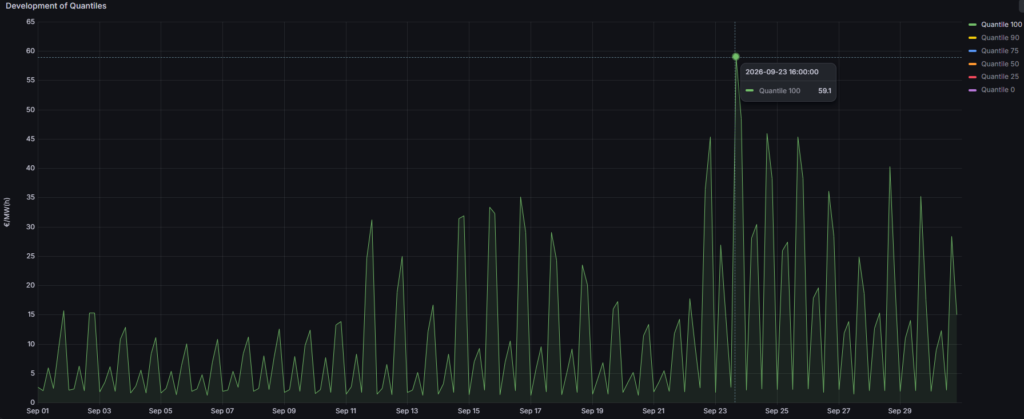
The aFRR+ remained calm until 10 September, with prices mostly below 16 €/MW/h. From 11 September, the first spikes above 30 €/MW/h occurred, becoming more frequent and higher toward the end of the month. The monthly high of 59.1 €/MW/h on 23 September at 16:00 exceeded the previous month’s maximum of 40.8 €/MW/h by 45%, and three further spikes exceeded that mark. In this market environment, FlexPowerHub achieved a bid acceptance rate of 89% with a forecast performance of 80%.
In the aFRR-, a daily rhythm repeated almost unchanged. At midday, high photovoltaic feed-in meets moderate demand, and the price rises to values between 50 and 85 €/MW/h. The monthly high of 96.1 €/MW/h on 8 September at 12:00 fits this pattern. In August, the Assumption Day holiday had still triggered 117 €/MW/h; a comparable special effect did not occur this time. For forecasting models, a recurring pattern is a favorable environment, which is reflected in the key figures: forecast performance rose to 99%, and the bid acceptance rate by 16% to 94%.
Germany
In the German aFRR+, prices remained calm until 9 September, mostly below 25 €/MW/h. The first spikes followed, of 56 €/MW/h on 10 September and 87 €/MW/h on 14 September. The most pronounced price spike occurred on 22 September: at 08:00, the price rose to 170 €/MW/h, and shortly afterwards two further spikes of around 120 €/MW/h followed. The maximum thus more than tripled compared to August (51.2 €/MW/h) but remains below the June value of 188 €/MW/h. Unlike in summer, when spikes in the aFRR+ occurred in the evening (July: 20:00), the highest value this time occurred in the morning. Several high spikes in quick succession made forecasting challenging, which is reflected in a forecast performance of 67%. The bid acceptance rate was 83%.
Running largely parallel to the Austrian market, the German aFRR- reached its monthly high of 94.5 €/MW/h on 8 September at 12:00, in the same hour as in Austria, which suggests that solar feed-in was the common driver in both countries. On 17 and 18 September, further spikes between 85 and 90 €/MW/h followed. Compared to August (110 €/MW/h), the maximum declined. The predictable pattern suited our models: forecast performance rose to 89% (+13%), and the bid acceptance rate to 93%.