
Marginal prices — an overview covering all markets
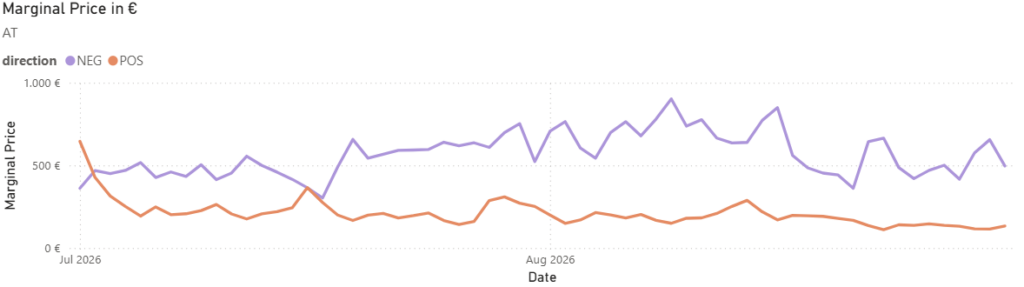
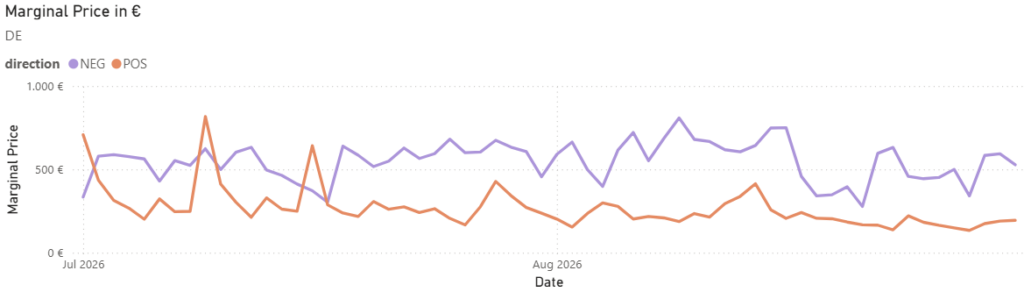
August across the balancing capacity markets in Germany and Austria was characterized by a clear continuation pattern. The fundamental turnaround from the previous month, in which the negative markets took the market lead, consolidated further.
We observed a continuous split: while the negative segments in both countries gained significantly in part, the positive direction lost pricing momentum across the board.
Due to the strength of the negative markets, this direction-driven market structure offered highly attractive revenue options for flexibilities. FlexPowerHub adapted to these dynamics through precise bidding strategies and unlocked the potential of the strengthening negative markets with high efficiency.
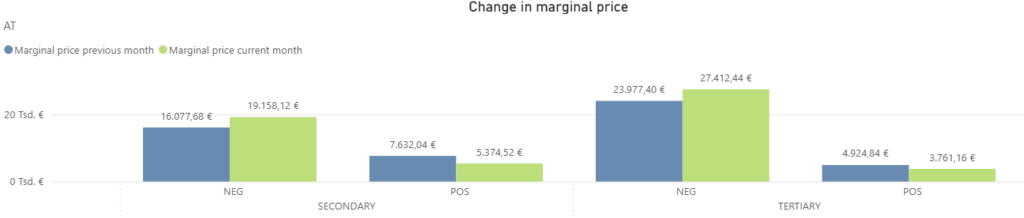
In Austria, the directionally split market reality was particularly evident in August. In the secondary balancing capacity market, the marginal price in aFRR- recorded a sharp increase of 19,16 %, climbing from 16.077,68 €/MW/h in July to 19.158,12 €/MW/h in August. This was offset by a noticeable cooling in aFRR+, where the price dropped by 29,58 %, from 7.632,04 €/MW/h in July to 5.374,52 €/MW/h in August.
This asymmetry was reflected even more strongly in the tertiary market. While mFRR- jumped by 14,33 % to 27.412,44 €/MW/h, marginal prices in mFRR+ plummeted by 23,63 % to 3.761,16 €/MW/h. FCR recorded a positive development. Following the slight cooling in the previous month, revenues in August rose by 5,86 % to 19.335,48 €, consolidating their solid level.
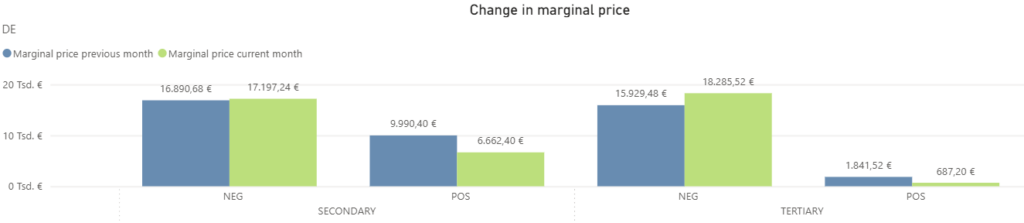
In Germany, an almost identical pattern emerged, underlining the close connection between both control zones. The German aFRR- operated at a very stable level in August and recorded a slight increase in the marginal price to 17.197,24 €/MW/h. A significantly more dynamic price increase characterized the mFRR-, where it rose by 14,79 % from 15.929,48 €/MW/h in July to 18.285,52 €/MW/h. On the positive side, the market stabilization continued further. In the aFRR+, the marginal price fell in August by 33,31 % from previously 9.990,40 €/MW/h in July to 6.662,40 €/MW/h.
A particularly sharp decline was experienced by the mFRR+, whose marginal price decreased by 62,68 %, from previously 1.841,52 €/MW/h down to just 687,20 €/MW/h. In contrast to Austria, German FCR developed slightly downwards and recorded a correction in revenues to 15.971,88 €.
Comparison of revenues generated with FPH and the market average in the aFRR
August confirmed the market split established in the previous month across the balancing capacity markets in Germany and Austria. The negative secondary markets presented themselves as reliable sources of revenue and recorded a further increase in market averages, while revenues in the positive direction declined across the board. FlexPowerHub addressed this market dynamic with targeted algorithmic adjustments. We succeeded in noticeably expanding bid acceptance rates in almost all declining segments and maximizing available revenue potential, while our forecasting models ensured continuously high revenues in the negative market.
Austria
In the aFRR-, the positive dynamics of the previous month continued forcefully. The market average climbed by 21,65 % from 12.349,40 €/MW/h in July to 15.022,88 €/MW/h in the current reporting month. FlexPowerHub followed this growth trend and increased revenues from 11.434,48 €/MW/h in July to 12.918,04 €/MW/h in August. As expected, following the extraordinary high of the previous month, the bid acceptance rate dropped slightly and settled at a solid 77,96 %. In this environment, our forecasting models convinced with a performance of 85,99 %.
In the aFRR+, the market stabilization that began in July continued further. The market average dropped by 28,60 % and fell from previously 6.219,48 €/MW/h to 4.440,40 €/MW/h in August. Similarly, the revenues achieved with FlexPowerHub also corrected by 18,48 % from previously 4.775,44 €/MW/h to 3.893,16 €/MW/h. Our placement reliability developed extremely favorably in this environment. The bid acceptance rate recorded a significant recovery, rising by 15,48 % from 83,33 % in July to 96,24 % in August. This success was accompanied by an increase in our forecasting performance, which climbed to 87,68 %.

Germany
In the aFRR-, the balancing capacity market presented itself at a very stable level in August. The general market average recorded a slight increase of 3,81 % from previously 13.522,92 €/MW/h in July to 14.037,80 €/MW/h. The revenues generated with FlexPowerHub followed this stable trend and stood at 10.653,24 €/MW/h, representing 95,02 % of the previous month’s value of 11.211,76 €/MW/h and thus meaning a minimal revenue drop of 4,98 %. A key driver for the continuously high revenue quality was an increase in our placement reliability. The bid acceptance rate climbed from an already strong 82,26 % in July by 9,80 % to 90,32 % in the current reporting month. Our forecasting performance in this consolidated environment reached a solid 75,89 %.
In the aFRR+, the general summer market cooldown was reflected even more clearly. The market average decreased by 30,95 % from previously 7.943,08 €/MW/h in July to 5.485,08 €/MW/h in August. FlexPowerHub was able to cushion this market decline, as our revenues dropped by only 24,34 % to close at 4.522,16 €/MW/h, which corresponds to 75,66 % of the July value of 5.976,80 €/MW/h. This development was driven by an increase in our bid acceptance rate, which soared by 17,65 % from previously 82,26 % in July to 96,77 % in August. At the same time, our forecasting performance improved, climbing from 75,25 % in the previous month to 82,44 % in August.

Market volatility
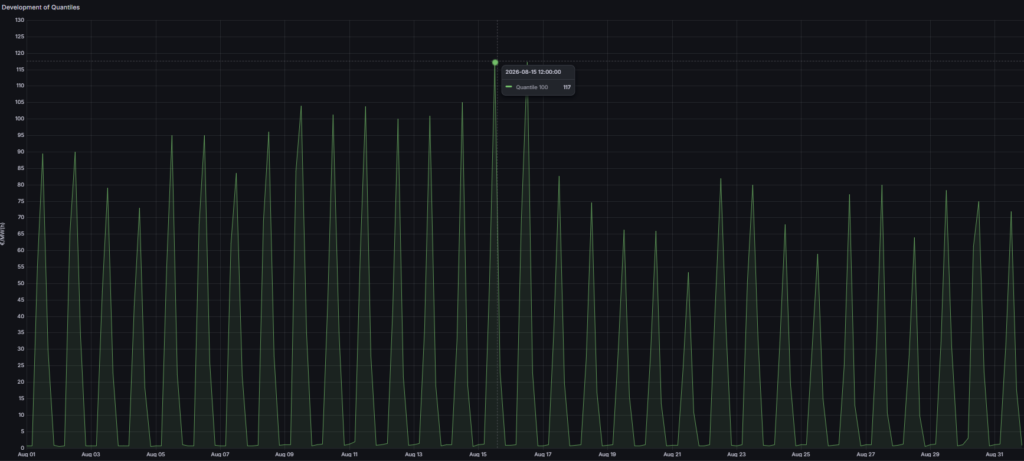
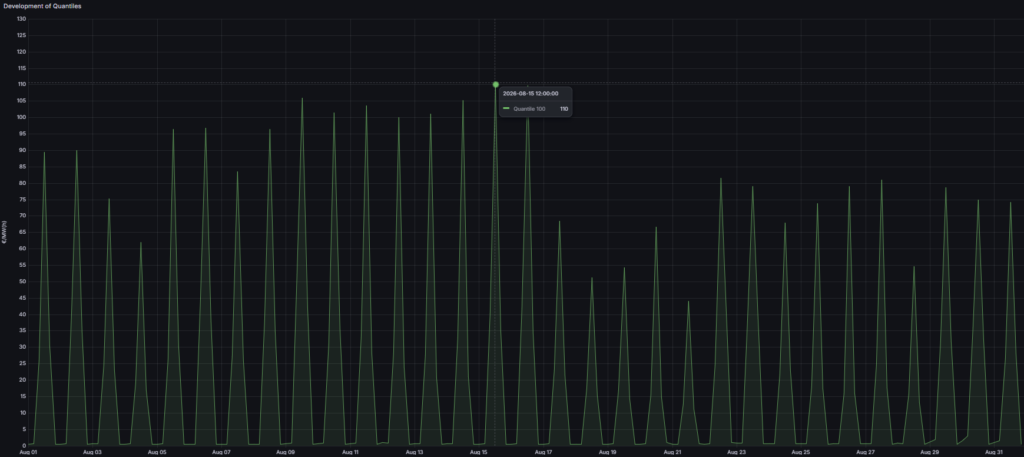
In August 2026, the aFRR market in Germany and Austria exhibited a clear split: while the positive segment (aFRR+) cooled down significantly following a dynamic July, the Assumption of Mary public holiday on August 15 generated a sharp monthly peak in the negative segment (aFRR-). The combination of reduced industrial load and high solar generation at midday pushed peak prices for negative balancing capacity to 117 €/MW/h in Austria and 110 €/MW/h in Germany.
Through agile algorithms and precise bidding strategies, FlexPowerHub was able to profitably leverage this holiday-driven peak volatility while also securing consistently high forecast performance in the quieter aFRR+ environment. The following sections analyze the individual markets in detail.
Austria
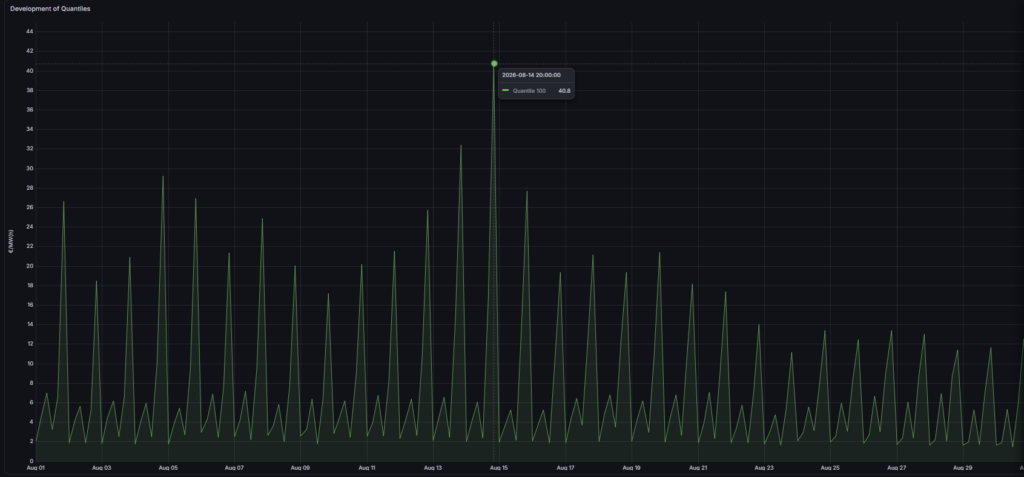
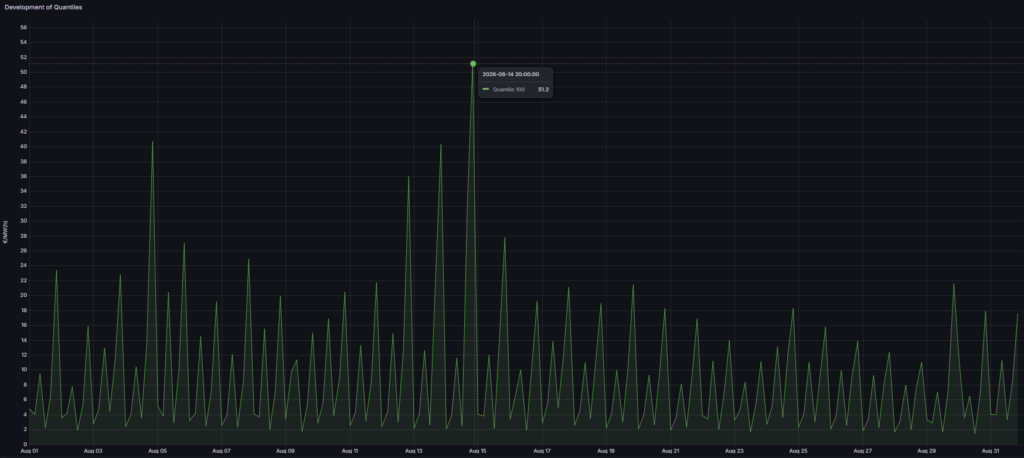
In the aFRR+, a significant cooldown occurred in August compared to the lively dynamics of the previous month. The absolute peak price of the month was recorded on the evening of August 14 at 20:00, reaching only 40,8 €/MW/h. Compared to July, when the maximum still stood at a substantial 95,9 €/MW/h, price levels in the positive segment flattened massively. The market offered almost no noteworthy price spikes, as the power grid remained consistently well supported with barely any unplanned generation outages needing to be compensated. Our algorithms adapted perfectly to this quiet market environment and secured a continuous market presence through a risk-optimized bidding strategy. This strategy achieved an outstanding bid acceptance rate of 96 % and a strong forecast performance of 88 %.
The aFRR- presented itself as stable over long stretches in August, but recorded a peak value of 117 €/MW/h on August 15 at 12:00. From a market analysis perspective, this striking midday peak can be clearly interpreted: it fell precisely on the nationwide public holiday Assumption of Mary, when industrial electricity demand was drastically reduced. At the same time, intense solar feed-in during the midday peak pushed enormous amounts of energy into the grid, leading to an acute electricity surplus. To maintain grid stability, the demand for negative balancing capacity spiked sharply and drove the marginal price to its monthly high. Compared to the previous month of July, in which the peak value in aFRR- stood at a more moderate 98,1 €/MW/h, peak volatility rose noticeably during this particular moment. FlexPowerHub reacted to this holiday-specific special situation with flying colors and utilized the volatile environment to generate top-tier revenues for our clients, supported by a solid bid acceptance rate of 78 % and a high forecast performance of 86 %.
Germany
In the aFRR+, the stabilization trend continued consistently in August. The absolute monthly high was set on August 14 at 20:00 at a moderate 51,2 €/MW/h. Thus, the positive segment experienced a drastic cooldown compared to the previous month of July, when peak prices still climbed up to 118 €/MW/h. Apart from diurnal fluctuations, a highly ordered market pattern established itself without extreme price jumps. FlexPowerHub agilely adapted its bidding strategy to the quieter environment, enabling our models to maintain an excellent balance between placement reliability and revenue quality despite the narrow margin window, delivering a high bid acceptance rate of 96,77 % alongside a forecast performance of 82,44 %.
The aFRR- mirrored the holiday-related events of the neighboring country almost identically. Here, too, the highest price spike of the month occurred on August 15 at precisely 12:00, with a peak of 110 €/MW/h. Since the Assumption of Mary is a public holiday in key industrial regions like Bavaria, the German transmission grid also experienced a pronounced combination of throttled load and maximum photovoltaic feed-in at midday. The resulting surplus required rapid intervention via negative balancing capacity. Compared to the previous month of July, which recorded a maximum of 105 €/MW/h, peak volatility in the German aFRR- remained at a very similar level. FlexPowerHub utilized this midday structure with high efficiency to achieve above-average placement success and high revenue quality through precisely modeled bid placements, achieving a bid acceptance rate of 90,32 % and a forecast performance of 75,89 %.
1DA vs. 2DA
The results for August demonstrate the economic leverage of market-aligned forecast placement. Even during phases of consolidation, the 1DA forecast delivered the crucial agility. FlexPowerHub consistently converted this precision in both countries into optimized bidding strategies, which resulted in higher bid acceptance rates and additional revenues compared to the 2DA benchmark horizon.
In the Austrian market, the results illustrate the role of the 1DA in revenue maximization across both directions. In the aFRR-, the 1DA recorded a bid acceptance rate of 94,62 % in August, while the 2DA stood at 93,55 %. This bidding reliability led to revenues of 12.297,76 €/MW/h with the 1DA compared to 11.932,16 €/MW/h with the 2DA. This corresponds to an additional revenue of 365,60 €/MW/h, or a relative revenue advantage of 103,06 % compared to the 2DA baseline.
In the aFRR+, the effect of the shorter time horizon was particularly pronounced in August. Here, the 1DA achieved a bid acceptance rate of 53,23 %, whereas the 2DA reached only 27,96 %. This lead directly translated into revenues of 2.231,08 €/MW/h for the 1DA compared to 1.326,92 €/MW/h for the 2DA. This resulted in an additional revenue of 904,16 €/MW/h, representing a revenue level of 168,14 % compared to the 2DA figure. Our algorithms capitalized on the proximity to the Gate Closure Time (GCT) to place bids precisely in the most valuable time slices.
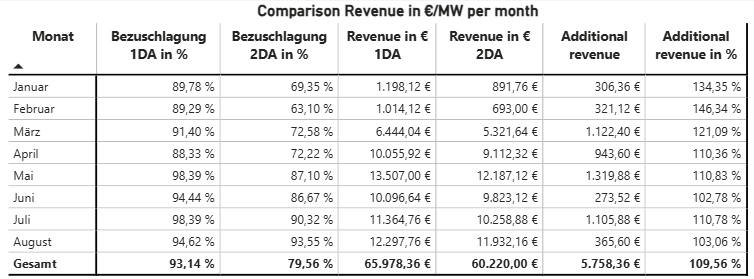
The German balancing capacity market seamlessly confirmed the superiority of the 1DA, also delivering added value. In the German aFRR-, although the 1DA achieved a bid acceptance rate of 80,11 %, slightly below the 80,65 % of the 2DA, it converted short-term signals more efficiently in financial terms. On the revenue side, our systems generated 8.188,40 €/MW/h with the 1DA compared to 7.549,28 €/MW/h for the longer time horizon. The resulting additional revenue of 639,12 €/MW/h, or 108,47 % of the 2DA baseline, demonstrates how the 1DA forecast unlocks additional optimization potential even during consolidation phases.
The 1DA delivered a strong performance in the German aFRR+, where short-term forecast quality played to its strengths. The 1DA achieved a bid acceptance rate of 74,73 %, while the 2DA reached 62,90 %. Financially, this translated into revenues of 3.856,32 €/MW/h for the 1DA compared to 3.456,76 €/MW/h for the 2DA. The resulting additional revenue amounted to 399,56 €/MW/h.
In summary, August 2026 also proves that the 1DA forecast remains the instrument of choice. Independent of market direction and country-specific conditions, the shorter forecasting horizon secures value creation for our clients’ flexibilities.
Click here to access our forecast dashboard, where you can view all values in detail.
